


The American Civil War was a very unique occurrence. It lasted four years, left 620,000 dead, and changed the way war would be fought for 70 years. It ushered in the age of total warfare; the idea that a population had to be defeated, not just their armies in the field. The War freed three and a half million slaves, spawned the Kl Klux Klan, brought about iron ships, advanced the Industrial Revolution, brought about numerous medical advances, expanded the rail system, and left Europe thinking the middle part of North America was nothing but a large Lunatic Asylum. Yet, through all of this, the boys of Portage County, Ohio, knew the war on an extraordinarily individualistic level.
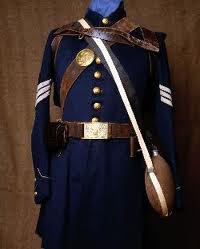 Their average height was 5’ 8’’. Average weight was 140 pounds. Most could read, and a few were college educated. Their hair ranged from long to short, and most had some form of facial hair. While fighting in the Eastern Armies the boys wore a forage cap…once out west they would have worn the slouch hat.
Our boys would have been issued a Union uniform, which consisted of a sack coat (wool), a pair of pantaloons (wool), a pair of wool socks, and a set of brogans. This outfit would have been fairly comfortable in April and October. In the other ten months it would have been extraordinarily hot, or extremely lacking against the cold. They were also issued a long sleeved cotton shirt, and a pair of cotton undershorts. Once a year these cotton accruements would be replaced for free.
Soldiers would have been issued a knapsack. When thinking of a knapsack, you can see it as an early form of a back pack. It was principally used to house the soldier’s blanket and his shelter half. See, during the Civil War the Union soldiers carried half a tent, and their bunk mate carried the other half. Their muskets, fitted with their bayonets, served as the poles. The knapsack also housed a rubber blanket, which kept the shelter half and blanket from getting wet.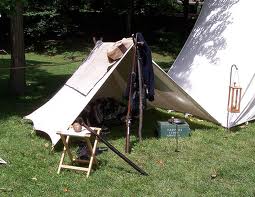
Our boys would have had a frying pan and a spatula. They would have carried a canteen.
Our boys would have carried a haversack. It was leather, and would be used to house your hardtack (flour biscuits), tobacco, writing utensils, eating utensils, matches, and other assorted items. It was also where our soldiers kept their letters from home, pictures, lockets, playing cards, comb (more for lice than grooming), and other assorted items that meant a lot to these men. The reality is that these soldiers lived very bare lives…their apparel and equipment was truly all they had.
Each Union soldier had a cartridge box. In it were the rounds they would use in battle.They also had a percussion cap box that affixed to their belt. These were the caps they would use to ignite the rounds in their cartridge box. A bayonet finished the typical outfit of our boys. It was held in a sheath that fit on the belt as well.
Our boys spent a lot of time trying not to be bored. Ask anyone who’s served in the military and they’ll tell you it’s a great deal of hurry up and wait. In the Civil War it was marching to a position, bivouacking, and starting a fire. The boys were always starting fires, and on those fires that almost always had coffee brewing. They drank it strong, often, and when they couldn’t brew it they would chew on the beans.
They ate a lot of hog. Salt pork was a staple in their diet, as well as thick bacon that created a fine grease for cooking. A treat for our boys was fried potatoes sliced thick with their pocketknives. If an onion could be found they considered it a feast…and a sliced apple in the mix was worth writing home about.
Our boys liked to play cards, to roll dice, to attend wrestling matches amongst their fellow soldiers, and drink alcoholic beverages. They drank whatever they could get their hands on, and when alcohol wasn’t available they made their own.
Our boys knew when a battle was coming, and they learned as best they could how to survive when the minnie balls started flying. Many of those who lived through the war realized that firing from behind a tree was considered as brave as firing from in front of it.
Our boys lived lean, hard lives. The battles of that war tend to be the defining points, but it was the day to day life that truly made the soldiers the men they became.