


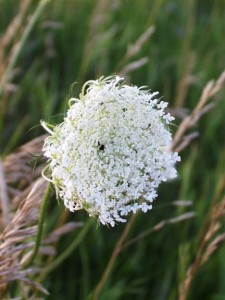
 Most of you are probably familiar with this pest. You consider it a weed. Poor beauty! Just like a queen whose crown and robe have been stolen and who has been thrown to the streets, so this lovely gal has had to endure such a life of rejection. But her history is quite impressive and her ‘children’ live on in almost every kitchen.
Queen Anne’s Lace is a biennial, living only two years. But, because it reseeds so easily, it does spread rapidly, and is almost impossible to completely do away with. It’s been here since the pilgrims, who probably were the ones who packed it with them, unknowingly, when they journeyed here. It looks stunning in field full of them in the kingdom it was meant to reign over– the wild. But of course is considered an invader and criminal in our own home gardens – at least for most of us who quickly sentence them to death.
If you pull a Queen Anne’s Lace out so that you get its root, you will actually be looking at a wild carrot. Just a thin, dirty root. As a member of the carrot family it has a long taproot and lacy leaves. Crush a wild carrot root and you will find that it smells just like a carrot! The flesh of the wild carrot is considered to have a strong taste, but without much of the sweetness of a domesticated carrot.It is edible when young but the root,especially the center, soon gets tough and woody.
The wild carrot has finely divided leaves like that of the domesticated carrot. Flowering wild carrot may grow four feet tall. At the end of the stem is a primary seedhead made up of numerous individual white flowers and in some a purple flower in the center together with drooping, narrow bracts on the underside. It’s really quite lovely in its own right.
 Medicinal Uses
The wild carrot is an aromatic herb that acts as a diuretic, soothes the digestive tract and stimulates the uterus. (DO NOT USE IF PREGNANT!) It supports the liver, stimulates the flow of urine and the removal of waste by the kidneys. An infusion is used in the treatment of various complaints including digestive disorders, kidney, and bladder diseases.
An infusion of the leaves has been used to counter cystitis and kidney stone formation, and to diminish stones that have already formed. A warm water infusion of the flowers has been used in the treatment of diabetes. A tea made from the roots is diuretic and has been used in the treatment of urinary stones.
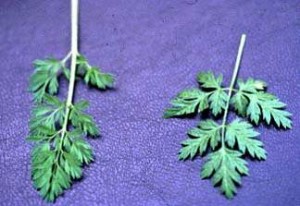 Wild Carrot/Poison Hemlock: How to tell the difference
Poison hemlock smells nasty; just roll some leaves between your thumb and forefinger, and smell. Wild carrot, especially the root, smells like carrots. Poison hemlock has smooth hollow stalks with purple blotches and no hairs on its stems. It can get quite tall, sometimes up to 8 feet or higher. It produces many flower heads in a more open and branching inflorescence. In contrast, wild carrot usually has one red flower in the center of the flower top and is usually about 3 feet tall, or less. Poison hemlock starts growing in the spring time, producing flowers in late spring, while wild carrot produces flowers later in the summer.
Here’s one great reason to think positively of this queenly plant! I suppose real carrots would work just as well, though, if you choose to keep your distance.
Wild Carrot Cake
From The Wild Vegetarian Cookbook
Wild carrots are especially good in carrot cake because they provide more flavour than commercial carrots do, and they’re still crunchy after cooking.
Unlike the usual cakes, in this recipe you add the icing before you bake the cake.
Icing
Two 19-ounce packages silken tofu, drained
3/4 cup dates, chopped
1/4 cup fresh lemon or lime juice
2 tablespoons arrowroot or kudzu
2 tablespoons fresh bread crumbs
1 tablespoon almond oil
2 teaspoons vanilla extract
2 teaspoons ground cinnamon
1 teaspoon liquid stevia or 2 tablespoons honey, barley malt, or rice syrup
1/2 teaspoon orange extract
1/2 teaspoon salt
Cake
4 cups (19 ounces) sweet brown rice flour and 4 cups (1 pound) oat flour, or 35 ounces any whole-grain flour
1 cup arrowroot or kudzu
3/4 cup plus 3 tablespoons freshly ground flaxseeds (6 tablespoons seeds)
2 teaspoons freshly ground star anise
1 teaspoon freshly ground coriander seeds
1 1/2 teaspoons freshly grated nutmeg
2 teaspoons salt
1 teaspoon baking soda
2 1/4 cups plus 2 tablespoons apple juice
1 cup corn oil or other vegetable oil
1/4 cup fresh lime or lemon juice
1/2 cup lecithin granules
2 teaspoon liquid stevia (herbal sweetener)
1 1/2 cups raisins
1 1/2 cups wild carrot taproots, grated
1. Preheat the oven to 350 degrees.
2. To make the icing: In a food processor, combine the icing ingredients and process until smooth.
3. To make the cake: Mix together the flour, arrowroot, ground flaxseed, spices, salt, and baking soda in a large bowl.
4. In a blender, combine the apple juice, corn oil, lime juice, lecithin granules, and liquid stevia and process until smooth. Mix the wet ingredients into the dry ingredients, being careful not to over mix. Stir in the raisins and grated wild carrots.
5. Divide the batter evenly between 2 oiled 12-inch round cake pans. Pour the icing over the cake batter in each pan. Bake the cakes until the bottom of each one is lightly browned, about 40 minutes. Let the cakes cool on wire racks before serving. (MAKES 2 CAKES)