


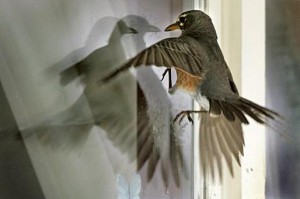
Chances are that you’ve heard a thud on the window only to discover a bird has crashed and fallen to the ground. You stand over it wondering whether it is going to be all right or not. Such was the case for me this February when I saw through the sliding glass doors, which lead into the greenhouse, a bird sitting eerily still. The greenhouse is attached to the kitchen and must be entered in order to go outside. Opening the door confirmed that he was in a daze as he did nothing to try to escape as you can see below.
I quickly realized he had come in through one of the roof openings (that need closing). Fortunately, after about 15 minutes, he recovered and was able to find the outside door I had opened for him to fly out through….before my cat saw him! But sometimes those collisions knock the bird out completely! In fact, according to the U.S. Fish & Wildlife Service, up to 1 billion birds may be killed annually by colliding with windows. Whoa!
Caring for an Injured Bird
Whether it’s from flying into windows or from another cause, birds have accidents too. Often, if just dazed or unconscious, they will recover with just a little help from us, but sometimes it is much more serious.
Never try to force food or water into its beak. This will not revive or help strengthen the bird. This is like trying to make an unconscious person eat or drink.
Instead, simply provide warmth and safety. Find an appropriate sized box, make ventilation holes in it, place tissue at the bottom of the box, and place the injured bird inside. Place the box on a heating pad set on low, then place the box in a very dark quiet place in your home. Sometimes, a few hours of rest and warmth are all a bird needs to recover.
If the bird doesn’t seem to respond after a reasonable amount of time, call a vet, who may know of a local wildlife rehabilitation organization for help, or try Birds in Flight Sanctuary in Warren.
They offer this information on their website for general signs that a bird needs rescue help:
- Bleeding
- An apparent or obvious broken wing
- A featherless or nearly featherless bird on the ground
- Shivering
- Evidence of a dead parent nearby
- Downy baby on the ground near children or animals
- Hopping around on the ground/unable to fly
DO NOT EVER GIVE FOOD OR WATER TO AN INJURED BIRD!
If a bird has any of the above signs, you should immediately call us at 330-652-3381
Birds in Flight Sanctuary
8655 Warwick SE
Warren, OH 44484
 Preventing Window Wipe Outs!
Despite having exceptional sight, birds have a difficult time seeing glass. Instead, they see the reflection of the sky and plants in the glass, which they think indicates a safe area to fly, particularly if they are startled or threatened. Large picture windows and corner windows are the most dangerous, but even small windows can sustain potentially fatal collisions.
While a strong window collision can kill a bird on impact, many times birds are stunned and appear to recover and fly away. Unfortunately, these injured birds may later suffer internal hemorrhaging and brain swelling that leads to death. Stunned birds may also be less agile fliers and more disoriented, making them vulnerable to predators. To prevent these incidents, birders can take many easy steps to make their windows more visible – and avoidable.
To help reduce window wipe outs, use a combination of these interior and exterior preventions.
Interior
- Install sheer curtains, interior blinds, or shutters.
- Remove houseplants near windows so birds will not consider them to be shelter or food.
 Exterior
- Break up a window’s reflection by adding decals, sun catchers, crystals, Mylar strips, windsocks or other obstacles outside.
- Add taut screens to window exteriors.
- Place thick planter boxes with flowers and shrubbery at the base of dangerous windows. This will encourage birds to land in the plants.
- Keep birdbaths and feeders closer than 3 feet to the window or further than 15 feet away.
With spring approaching, mating season will bring increased possibilities of window collisions. This is when the birds are most territorial and they view the reflection as another bird intruding on their territory and try to chase it away. Most species do not recognize the reflection as their own self. By using some of the above techniques, you can help save birds from some serious or even fatal wipe outs!
So decorate those windows, folks! Just make it a part of your annual spring cleaning! Once breeding season in over, it won’t be as critical and you can remove some of the ‘decor,’ but it’s a good idea to leave some in place.
If you know of any nearby bird rehabilitation centers, please leave the name in the comments below. Thank you!